




About Property Care Association
Promoting skills and good practice to help you care for your property

[edit] PCA Mission Statement
To promote high standards of professionalism and expertise within the industry through training and other support services. To promote these standards outside the Association to ensure that members of the Property Care Association are perceived as the best providers in these specialist sectors: structural maintenance, timber preservation, damp and condensation control, flood protection and remediation and the control and management of invasive weeds.
With a comprehensive training programme and a wealth of information for members, industry professionals and householders, the Property Care Association works to be the industry expert. Always striving to promote the work of the specialist contractor to clients, the PCA provides an industry voice on behalf of members. We work with government departments, respond to consultation documents and provide assistance with the development of new guidelines, all with the aim of improving outcomes and promoting best practice.
[edit] PCA promotes excellence through:
- Ensuring that members adhere to strict membership criteria. The provision of a comprehensive range of training courses specifically designed to focus on the specialist areas of work that PCA members undertake. The courses lead on to qualifications.
- An ongoing audit of contractor member companies, ensuring that all aspects of their businesses operate to the highest standards. This involves checking company systems & procedures, health & safety practices and staff development and training programmes.
- A regular programme of site inspections to which all contractor member companies are subject. PCA appoints an independent inspector to visit sites and confirm that good practice is maintained in clients’ domestic and commercial premises.
- Increasing standards to improve consumer confidence. As a founder member of TrustMark, PCA members are validated through this government backed scheme which declares that all contractors working in the domestic environment are trustworthy and competent.
- Supporting opportunities for Continuing Professional Development to enable members to maintain and develop their knowledge and skills in waterproofing, damp control and timber treatment.
[edit] History
Established in 1930, the British Wood Preserving Association (BWPA) was the founding body for the industry with the key aim to ‘spread knowledge of wood preservation with a view to prevent wastage of timber and to standardise specifications for wood preservatives and their application; to investigate all possible methods of wood preservation; and to afford members opportunities for the interchange of ideas regarding improvements in wood preservation’ (extract from the BWPA inaugural meeting).
In 1977, the British Chemical Dampcourse Association (BCDA) was formed and in 1989, the two Associations merged to form the British Wood Preserving and Damp Proofing Association (BWPDA). Members of the BWPDA were instrumental in the formation of Guarantee Protection Trust in 1982, to offer insurance-backed guarantees to customers, which became Guarantee Protection Insurance on achieving FSA approval in 2002.
In 2003, two divisions were created; the Property Care Association and the Wood Protection Association. In 2006, members of the BWPDA voted for the separation of the PCA and WPA. Shortly after that they became individual Trade Associations in their own right.
IHBC NewsBlog
Lady Grange’s House repaired on St Kilda
.jpg)
National Trust for Scotland repairs stone cleit with link to famous island resident
Griff Rhys Jones on BBC Radio 4 Today programme
,_Green_Lane,_Derby.jpg)
The Victorian Society’s President unveiled its latest Top Ten Endangered Buildings 2026.
Need a MATE? Book your place now.

IHBC offers free webinars on applying for IHBC accreditation (Full & Associate).
UK Stained Glass Repository finds windows new homes

How are stained glass windows are rescued, stored and repurposed?
APPGEBE report sets high aims for quality
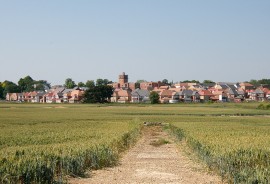
'Government must not sacrifice quality in drive to build 1.5m homes'
New measures protect Historic Shipwrecks from heritage crime

Underwater cultural heritage benefits from new HE guidance
How could the City of London skyline look in 6 years' time?

Visualisation shows approved planning applications as completed buildings
National Trust for Scotland calls for VAT cuts

Heritage neglect is encouraged by current policies
IHBC's 'Context' Issue 186 features Industrial Heritage

IHBC's members' journal reports on the challenges of conserving infrastructure
Book now for IHBC Annual School 2026

IHBC Annual School is taking place 18-20 June 2026 in Newcastle
RICHeS Research Infrastructure offers ‘Full Access Fund Call’

RICHeS offers a ‘Help’ webinar on 11 March
Latest IHBC Issue of Context features Roofing
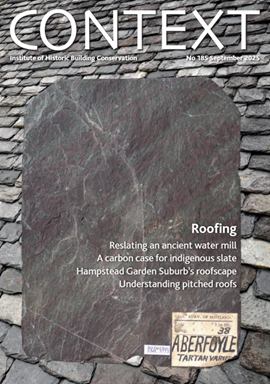
Articles range from slate to pitched roofs, and carbon impact to solar generation to roofscapes
Three reasons not to demolish Edinburgh’s Argyle House

Should 'Edinburgh's ugliest building' be saved?
IHBC’s 2025 Parliamentary Briefing...from Crafts in Crisis to Rubbish Retrofit
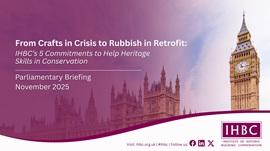
IHBC launches research-led ‘5 Commitments to Help Heritage Skills in Conservation’
How RDSAP 10.2 impacts EPC assessments in traditional buildings

Energy performance certificates (EPCs) tell us how energy efficient our buildings are, but the way these certificates are generated has changed.