





Running mean temperature
When people are dissatisfied with their thermal environment, not only is it a potential health hazard, it also impacts on their ability to function effectively, their satisfaction at work, the likelihood they will remain a customer and so on.
Thermal comfort is dependent on environmental factors, such as air temperature, air velocity, relative humidity and the uniformity of conditions, as well as personal factors such as clothing, metabolic heat, acclimatisation, state of health, expectations, and even access to food and drink.
In the 1970s the existing, ‘steady-state’ theory of comfort was challenged by an adaptive comfort theory which suggested that comfort was time dependent, as the occupants of a building would adapt to their environment over time, adjusting clothing, modifying behaviour and so on. This suggested that the occupants of a building might actually accept conditions that would otherwise have been predicted to be unsatisfactory.
It was proposed that an exponentially-weighted outside running mean temperature could account for this time-dependency.
The equation for the exponentially-weighted running mean temperature for time T is:
Trm = (1-α){T(t-1) + αT(t-2) + α²T(t-3)…..}
Were Tn is the temperature at each time interval, and α is a constant between 0 and 1. The temperatures Tn become less significant as time progresses, with the speed of decay depending on the value of the constant α. The lower the value of α, the less significant the weighting of past temperatures.
[edit] Related articles on Designing Buildings Wiki
Featured articles
Check out some of the best features and news from Designing Buildings as well as key stories from around the web.
Building Safety Act implementation in Wales

CIAT to host industry panel on 26 June.

New and updated CLC building safety guidance.
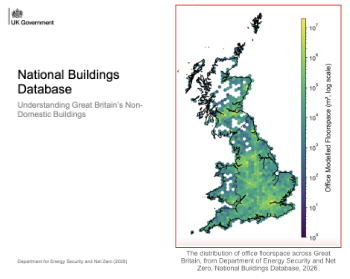
New UK National Buildings Database.
Building Safety Wiki Interviews

Chief executive of the British Woodworking Federation.
Planning condition discharge in England and Wales

A brief explanation from a building compliance expert, with further links.
Overheating guidance and tools for building designers

Guidance for dealing with element of building fabric control that have increasing importance.
Shading for housing, a design guide

From the Good Homes Alliance and British Blind and Shutter Association.
UK Standard Skills Classification (SSC)

A shared framework for describing skills needs.
Social media ban consultation comes to close

CIOB urges UK Government to consider social media’s role in careers guidance in ban debate.
The latest of eight Skills England apprenticeship units

The addition of battery manufacturing welcomed by ECA with a warning about the risks of fast-tracked apprenticeship units.
Building Control Independent Panel final report
A precis of a key report led by Dame Hackitt with full recommendations and link to the government response.