






Complexity theory
MM Waldrop in his book, Complexity: the emerging science at the edge of order and chaos (1992) noted:
“…that corporations and industries evolve for better survival in a changing environment. And the marketplace responds to changing tastes and lifestyles, immigration, technological developments, shifts in the price of raw materials, and a host of other factors. Finally, every one of these complex, self-organising, adaptive systems possesses a kind of dynamism that makes them qualitatively different …… Complex systems are more spontaneous, more disorderly, ..[yet].. at the same time, however, their peculiar dynamism is also a far cry from the weirdly unpredictable gyrations known as chaos. These complex systems have somehow acquired the ability to bring order and chaos into a special kind of balance.”
Complexity theory arises between order and chaos.
“Complex systems tend to locate themselves at a place we call the edge of chaos. We imagine the edge as a place where there is enough innovation to keep a living system vibrant and enough stability to keep it from falling into anarchy. Only at the edge of chaos can a complex system flourish.” (Malcolm, 1995)
Research has shown that complexity is very similar to chaos theory (Decker, 2000; Flood, 1988) but that it requires a structured environment to exist. The majority of research (Ambos-spies, 1993) into complexity has followed on from chaos theory, but it is still an emergent theory with many unknowns. As a result, there is no standard definition.
Research on complex systems in biology (Phelan, 1995) has focused on the use of cellular automata. These models control single cells via a set of rules or by the state of their immediate neighbours. The Game of Life, a simple computer program that was popular among programmers in the early 1980’s, is a well-known form of cellular automata. (Wolfram, 1986; Hubler, 1986).
Complexity is well suited to specific physical or chemical applications (Lloyd, 1995; AppliedFutures, 1998) as they are very chaotic but are based solely around a well-structured environment. As an example of the potential application of chaos-based theoretical models, see Biomimicry.
The text in this article is based on ‘Business Management in Construction Enterprise’ by David Eaton and Roman Kotapski. The original manual was published in 2008. It was developed within the scope of the LdV program, project number: 2009-1-PL1-LEO05-05016 entitled “Common Learning Outcomes for European Managers in Construction”. It is reproduced here in a slightly modified form with the kind permission of the Chartered Institute of Building.
--CIOB
[edit] Related articles on Designing Buildings Wiki
[edit] External references
Featured articles
Check out some of the best features and news from Designing Buildings as well as key stories from around the web.
Where performance meets practice

The Building Envelope Stage at UKCW Birmingham.

CIAT publishes briefing on planning reforms.
Leaders in Learning for Practice Network

Call for conservation leaders in learning to register interest in new network.
The importance of early engagement

Construction lessons from the Trillium HealthWorks Experience Centre.
Mayors are to be given planning call in powers

Mayors across England will be able to make the most important planning decisions.

The Master Builder: William Butterfield and his times. Book review.

Why construction can't afford to ignore the skills gap.
Building Safety Regulator, 19 August

Gill Kernick appointed Independent Chair of Residents’ Panel.
Connecting knowledge, technology and conservation
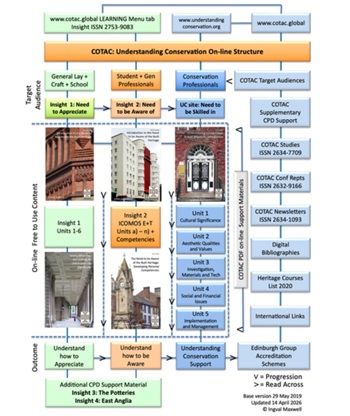
Building competence for the future of built heritage.
Building Regulations and Building Safety Act

CIOB publishes free advice for non-domestic clients.

Building Safety Newsletter from MHCLG.

An extraordinary record of steel engineering worldwide.