





About DUNYA ABDULAZEEZ GHENI ALDHAHER
I am architect in Ministry of Construction and Housing/Iraq with B.Sc in Architecture from Iraq 2011 and M.Sc. in BIM from UK 2015.

Every person has a responsibility to keep the earth clean, green and healthy, as it’s created for us and we have to save it by our knowledge. The title of my Masters dissertation (which I had completed in October 2015) is “How Can Building Information Modelling (BIM) Tools and Workflows Assist Architects to Optimise Their Design and Achieving Energy Efficiency Results?”. The idea of the title has been selected as the building and AEC industry contribute in energy consumption from the first stages of construction till the end of its life-cycle (demolition). Therefore, we (the architects) need to find many positive solutions to reduce or eliminate the problems related to energy consuming or its loss. With the emergence of sustainability and BIM, the performance analysis is necessary from an early design phase. The architects' works and services are required from the concept stage to the handing over stage as they represent the main contributors in AEC industry.
The Aim of my research is to investigate the use of BIM and energy analysing tools used by architects during the design process to achieve energy efficient and sustainable buildings. Then, the research will develop the integration between energy analysis tools with BIM. In addition, the methodology to support my work is an online questionnaire among architects who have experience and are currently working with BIM and energy efficient building, as well as, a project case study.
The case study result (ATRiuM 2b, Cardiff/UK): Describe a process of exploring different energy saving alternatives of the embodied and operating energy in the early stages of the design's life-cycle using BIM and energy analysing software programmes with regards to low carbon emissions, low impact design and low energy demands.
Case study (project) illustrated the possibilities and options to reduce the energy consumption for a case study of ATRiuM 2b by using orientation, efficient materials, design size and shape; and shading surfaces. The BIM-based energy analysis model has run by; developing BIM model, proper software application for energy simulation and integrating BIM with energy simulation to optimise BIM-based energy model. Suggestions for alternatives sustainable options for the design by Revit and Green Building Studio (GBS) were required to assess their impacts on the energy consumption. Revit software and GBS offer the ability for architects to work with 3D BIM and energy analysed model in an efficient way.
Featured articles and news

We're expanding our collaborative mission by launching DB Intelligence, an exclusive market research advisory panel. Built environment professionals can now get paid to share their expertise on industry trends, products and services.
Panel members receive direct financial incentives for participating in research projects like short surveys, 1-2-1 interviews and focus groups. Register today to shape the future of the construction sector.
Planning condition discharge in England and Wales

A brief exoplanation from a building compliance expert, with further links.
Overheating guidance and tools for building designers

Guidance for dealing with element of building fabric control that have increasing importance.
Shading for housing, a design guide

From the Good Homes Alliance and British Blind and Shutter Association.
UK Standard Skills Classification (SSC)

A shared framework for describing skills needs.
Social media ban consultation comes to close

CIOB urges UK Government to consider social media’s role in careers guidance in ban debate.
The latest of eight Skills England apprenticeship units

The addition of battery manufacturing welcomed by ECA with a warning about the risks of fast-tracked apprenticeship units.
Building Control Independent Panel final report
A precis of a key report led by Dame Hackitt with full recommendations and link to the government response.
Building Safety recap April, 2026
A short and longer run-through of the month, with links to further information and sources.
CIAT May 2026 briefing.

From medieval scribes to modern word art.

ECA welcomes crackdown on late payment and push for clean energy, whilst CIOB seek fixed cladding removal timeframes.
Cyber Security in the Built Environment
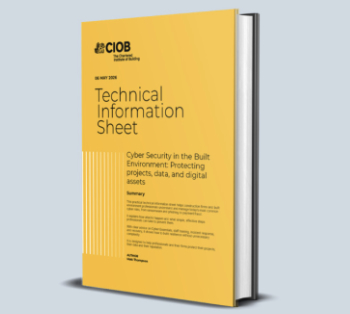
Protecting projects, data, and digital assets: A CIOB Academy TIS.
Managing competence in the built environment

ITFG publishes new industry guide on how to meet the ICC principles.
The UK's campaign to reduce noise pollution: Mythbusting, articles and topic guides.